Showing posts with label flowers. Show all posts

Thursday, 11 August 2016

There's Just No Gettin' Around It...Dinosaurs Are COOL!

Cool...but I'm still glad they're gone.
It's unlikely that international visitors to Western Canada would miss an opportunity to visit what is likely the Mecca of the dinosaur world; the Royal Tyrrell Museum. We first visited the museum in 1986 shortly after it opened. Back then it wasn't “Royal” yet, but it was still very impressive. Since we wanted to give the museum a chance to a add something new before we visited again, we hung on for about 30 years until we went back for another look, Sure enough, it was MUCH better this time, and worthy of the addition of the Royal appellation to the name.

The Royal Tyrrell Museum nestled in the badlands of Southern Alberta.
Travelers that find themselves anywhere in the vicinity of the town of Drumheller in the "badlands" of Southern Alberta would find it well worth their time to keep about 3 or 4 hours free for a trip back in time...way back. Admission is only $18 for adults, which would barely get you a burger and fries in a sit-down restaurant these days, and I guarantee you'll remember your day at Tyrrell long after you've forgotten a good burger.

Dramatic diorama-style staging of the first gallery gets you in the mood to learn more about this prehistoric world.
The museum features ten galleries, and the first (Cretaceous Alberta) is brilliantly executed in a way that sets the stage and builds anticipation for the rest of your exploration of the 121,000 square feet of spectacular displays. It features an up close and personal meeting with our very own local cousin of the T. Rex, the enormous top-of-the-food chain predator; Albertosaurus.

  In Cretaceous Alberta "objects in the mirror may be closer than they appear..."
After you leave the “you are there” realism of the first gallery, we visit a well presented historical retrospective of the museum's development and the astounding and significant finds from the region.

One of the most important T. Rex skeletons ever found.
While there are some special exhibits (like the T. Rex shown above) that will change from time to time, there will be a similar gallery to gallery flow for future visitors. That flow is not random, and the thoughtful arrangement adds to the pleasure of exploring the museum.

Truly impressive Triceratops skull.
We next get a look into the working “Preparations Lab” where you can see real work being done on the remains of these long dead creatures. If you've ever imagined yourself on your knees in the field as an archaeologist, scraping at an exposed dinosaur leg bone and then brushing away the sand with a fine paintbrush, the preparations lab will give you a look at how it really happens.

The Preparations Lab, where the real work takes place.
The next gallery, the “Lords of the Land” is in some ways the most beautiful and moving of them all. Here dinosaur bones are raised to the level of art, and are presented as such. This dark and beautiful room presents the displays as if they were sculptures or paintings, sometimes complete with frames. Here you will see a graceful and beautiful Velociraptor that is literally “put up on a pedestal,” and while beautiful, you'll be glad that nobody has actually cloned them back to life as explored in “Jurassic Park.” (A nice creature to visit, but I wouldn't want them to live here.)

The beautifully displayed remains of Velociraptor are raised to the level of art.
The gallery's centerpiece is J.B. Tyrrell's initial big find, the Albertosaurus, and the gorgeous “Black Beauty,” a rare black colored skull of a Tyrannosaurus Rex. (Note to geneticists: If you ever really do develop the ability to re-introduce these things...DON'T!)

Tyrrell's "big" find - Albertosaurus.
Heading up the ramp to the second level, we move on to the “Burgess Shale” where we see an ingenious “all around you” depiction of the bizarre and almost alien creatures that lived in the area of the Canadian Rocky Mountains more than 500 million years ago. While generally fist-sized in their real lives, here we see them as many times that size in order to let us feel as if we are swimming among them in an ancient otherworldly sea. Even the floor is glass so we see the animals below us as if we were floating in the water above them.

The bizarre creatures of the "Burgess Shale" gallery. Hmm...maybe with a little garlic butter?
A wonderful surprise to us was the small but beautifully crafted “Devonian Reef.” More a display than a gallery, it offers us a look at the underwater world of the Devonian period when the badlands of today were covered by an enormous tropical sea. Using a “dry for wet” technique, we get the benefit of seeing a most realistic presentation without any of the peskiness of having to deal with any actual water.

The "Devonian Reef" display is a realistic underwater scene.
Scuba divers will note that the changes in the creatures that inhabit our world's reefs over the eons have been much less dramatic than those on land. They will also note that the museum did a good job of depicting what the surface of the ocean looks like when you're below it.

Prehistoric calamari.
Small, but important, the "Terrestrial Paleozoic" gallery then takes you “...through over 200 million years in ten paces.” Covering the period during which life was moving out of the ocean and onto dry land, this part of Earth's past boasted dragonflies the size of actual dragons. (Well, not quite, but their wingspans were more than 2 feet).

A dragonfly the size of an eagle.
Here a happy childhood memory was crushed when I learned that one of my favorite dinosaurs, the sail-backed Dimetrodon wasn't even really a dinosaur at all, but a “mammal-like reptile.” However, without this guy, we might not have our dogs and cats today, as Dimetrodon and his like gave rise to modern mammals. I wonder if it barked?

Dimetrodon's "sail" may have been for body temperature regulation - a combination solar panel & radiator.
The next gallery, “Triassic Giant” offers the museum visitor a unique opportunity to walk around the remains of a truly enormous sea creature from our past, an Ichthyosaur (properly known as “Shonisaurus Sikanniensis”). Measuring 69 feet (21 meters) in length, the portion of the fossilized remains that were recovered are laid out on the floor atop a painted black outline of the original size and shape of the living creature.

This is how the "Triassic Giant" looked when it was still swimming around.
This is the largest known marine reptile to have existed, and like the baleen whales of today, was a filter feeder. There is something about this cleverly designed room that underscores the true sense of scale when viewing this fossil that other galleries and displays do not. Despite its apparent simplicity it was a most memorable part of our visit.

The gallery provides a real sense of scale for the viewer.
Easily missed near the exit to the “Triassic Giant” gallery is the entrance to a beautiful and restful tour through the “Cretaceous Garden.” A greenhouse of sorts, the garden features what is billed as “Canada's largest collection of prehistoric plant relatives.” This provides the viewer with an opportunity to imagine the desert-like landscape that surrounds the museum today as the lush, tropical, shallow sea and marshland that existed when the fossils showcased at Tyrrell lived and breathed. Even the pest control is all natural here, employing toads, salamanders, and ladybugs instead of ten-syllable chemicals. Don't miss this warm and humid walk through the past, especially if you're visiting during a cold time of year.

A "relative" of a prehistoric flower.
The spectacular "Dinosaur Hall" is still...well....spectacular, and in some ways remains the central display area of the museum. The Hall lets the visitor place him or herself into the world of the dinosaur, at least for a while, and I'm glad that we never really co-existed, Hollywood “evidence” notwithstanding.

A "before and after" style display is common in the Dinosaur Hall.
The feel of the room is starting to show its age, and it now has a nostalgic vibe that hearkens back to our childhood schoolroom ideas about what dinosaurs were all about. Back then, we kids stood on firm ground with what we “knew” about them (like my Dimetrodon) and nobody could have shaken us from our confidence that there really was such a thing as a “Brontosaurus.” I was heartbroken when we were later told that it was really just an Apatosaurus all along. But hold on! Paleontologists have recently decided that our beloved childhood swamp-plant-muncher really was a distinct creature after all. Yay Brontosaurus! (I know how Pluto must have felt when it got demoted to “dwarf-planet” status...but I think they really prefer to be called “little-planets” these days. Maybe it will make a comeback as a real planet too).

The guest can study these specimens very closely.
Nestled in the center of Dinosaur Hall is the dark and beautiful “Marine Hall.” In this gallery, the skeletons of enormous sea creatures cavort and swirl around us and overhead in a display that cleverly gives a sense of being undersea and at the very center of the action. Sort of like what a diver feels in a swirling mass of reef fish, but if the fish were all twenty feet long and had teeth like crocodiles.

"We need a bigger boat..."
Now we had back toward the present day as we enter the “Ice Age.” Here, despite the Arctic setting, the creatures are more familiar, looking more like alternate reality versions of elephants, bison, and cougars. Familiar or not, I'm glad that it's a deer that we risk hitting on the highway these days instead of a ten foot tall, 8 ton, woolly mammoth.

If those cats pull this off...they'll eat like kings!
Our final stop before returning to the present is “Mammal Hall.” While mammals actually developed right alongside dinosaurs, they were mostly small creatures (and really scared...ALL the time) until dinosaurs met their still somewhat mysterious demise. With the ecological niche cleared by the absence of all those twenty-five foot tall meat eating monsters, mammals had a chance to get bigger...much bigger. Our own early ancestors were probably pretty happy to have access to a herd of slow, docile, plant eaters from which they could obtain a decent steak.

I'm bettin' there'd be a few good roasts on that guy...just sayin'...
Finally, inevitably, we complete our journey through the incredible history of our planet in the time honored fashion that has itself been passed down through the ages as we “exit through the gift shop.” If you can't find an appealing souvenir widget or thing-a-ma-bob in here to put on your desk or hang from your rear-view mirror, it's really your own fault. Beware those of you that bring small children. This place is chock-a-block with plastic toy dinosaurs of every shape, size, and type, so make sure you have plenty of room on your credit card. As for me...hmmm...I like those speckled blue “Tyrrell Logo” bistro style coffee mugs...and we really ought to have some little memento...”Vicky!...Honey!...What do you you think of these?...”


Fox & Vicky


Saturday, 15 November 2014

Jewels

Okay, I admit it. I'm too busy either preparing to travel, travelling, or recovering from travel, to actually write about travel. That is irony...right? In fact, the date on the post prior to this one has been taunting me so aggressively regarding my failings, that I feel compelled to get something up here just to make it stop. (I would just hate to end up being one of those writers that "think" about writing a great deal, but never actually writes). Now that my confession is out of the way, I will regale you all with another post regarding our time "Down South" which indeed had sufficient effect on our lives to warrant another visit...

Enjoy!


I’m walking along one of the roads that run parallel to the waterfront, but it’s not one of the roads a tourist would be likely to see. There are no jewelry stores and no T-shirt shops. No one is asking me to come inside because they “have the best junk,” or “speak broken English perfectly.” No enormous white ships can be seen sitting offshore like office buildings lying on their sides. None of the things twenty thousand cruise passengers a day might remember about this island are on this street, but it does have a few attractions of its own. I pass a bougainvillea, pouring over a mission style wall like a waterfall, exploding with red flowers. The color is so intense in the setting sunlight that it doesn’t even seem real. On my left now is a bright orange house I never tire of seeing. The locals are fearless about their use of color in decorating, with vibrant yellows, blues, and reds everywhere. My neighborhood back home was brown and gray. The sidewalk under my feet is mostly cracked concrete, but in the center of every rectangular section is a small, bright-blue square of tile, set like a jewel. Jewels of a different kind for those of us that pass this way. 

Orchid Growing Wild In Our Back Garden - Cozumel, Mexico
Yin and yang, good and bad: each needs the other. I enjoy the frequent blasts of beauty I see while walking here all the more, because ugliness is not that rare either. Cozumel is never neutral, and never dull. One minute I might pass a house or restaurant and exclaim, “Oh my god! What is that smell?” as the intoxicating aroma of a delicious meal being prepared escapes into the air. The next, while passing a vacant lot, might produce the same exclamation -- but for a different reason entirely -- as I smell something dead and decaying amongst the garbage and empty beer bottles. It’s a feast for the senses here, but good or bad, everything is set to maximum. When I returned home for a visit last summer, I was struck by how ordinary everything seemed. There were identical houses with identical lawns, no highs and lows, no wild oscillation in the range of sights and smells. Beauty isn’t as valuable without anything to compare it to.

Mayan Ruins - San Gervasio Site - Cozumel, Mexico
I walk past a "municipal jungle," my name for the empty lots dotting the town. Green rectangles of unrestrained nature, they are usually bordered on four sides by man's handiwork. In these places nature makes a stand, and fights back with a ferocity that can only be seen in the tropics. I smile at the notion that the whole island looked like this once, and would look like it again if it were not held at bay every single day. Sky-blue flowers, the size and shape of a petunia are everywhere, giving the jungle the look of an out of control garden. A young egret stands near one border of this wild spot like a garden ornament: slim, graceful, and white. But it’s real, and a reminder that nature is patiently waiting to take over if it gets the chance. I often hear we need to save the planet, but I think the planet will do just fine by itself if one day we aren’t around to interfere; it’s we that need to be saved from ourselves. 

Iguana - So common that they're the "gophers" of Cozumel, Mexico
I heard a parable once about an old man standing near the gates of an ancient walled city. A family approached carrying all their belongings in a wagon. The father spoke to the old man, telling him they were looking for a new place to live, and asking him what he thought of this city. The old man asked, “What was the place you came from like?” The father answered, “It was a terrible place, dirty, ugly, and full of liars and thieves. No one was kind and everyone looked out only for himself.” The old man replied, “You won’t like it here then, because this city is just like that.” With this, the family moved on. Soon another family approached and asked the same question of the old man, as they too were looking for a new place to live. Again, the old man asked, “What was the place you came from like?” They answered, “It was a wonderful place, clean and beautiful, full of loving and kind people that were always ready to lend a helping hand.” The old man said, “Then you will like it here, because this city is just like that.” Well Cozumel is just like that too, and like any other place, it is exactly what you make of it.

Performers In The Annual Carnival Parade - Cozumel, Mexico
The sun has plunged toward the sea now, seeming to set faster here somehow. The sky to the west is on fire with yellow and orange and red. The clouds look like something from an oil painting, illuminated from within as if they are the source of this light and color. I’m on my way to a local nightspot. It’s not some noisy bar full of twenty-somethings, swilling beer and flashing their tattoos and body piercing. It’s a quiet oasis of cosmopolitan flair called Ambar, another example of the surprising range of this place. I walk through the lounge; past eclectic art and machine turned tabletops, thinking this place would be at home in the most hip of districts in any metropolis. I head through the back door into a garden seating area, where jazz plays softly from speakers hidden in the plants. I love the way the architecture in Mexico blurs the distinction between indoors and out. Vicky is waiting for me at one of the tables, with two ice-cold bottles of dark beer at the ready. The moon is full, or nearly so, and those areas not lit by the garden lights are bathed in bright blue moonlight. I shake my head, thinking that back home the snow is two feet deep and it’s thirty degrees below zero. We clink our bottles together, making a toast, and drink deeply; it’s hot out tonight. 

The Harbor At Christmas - Cozumel, Mexico
Travelers to places like this probably go home thinking they have a notion of what it’s really like here. They tell their friends and family they have been to Cozumel. Sadly though, they have likely seen only a sanitized and carefully prepared set, designed to empty as much cash from their wallets as possible. Avenida Rafael Melgar, the main shopping street along the waterfront, is all of Cozumel most people will ever see. They are warned not to wander onto the dangerous back streets, and to be wary of the local eating establishments. Patent nonsense, as this is the safest place I have ever been, and I’d rather trust local restaurants (that feed their friends and families day after day) than tourist joints that serve you once and never see you again. Make the effort to break free of convention and see the real Cozumel, because you won’t find it on Melgar. Sure, you might see some garbage on the streets, or smell something bad, but you might see some unexpected beauty too.

Sunset From The Ventanas Al Mar (Windows To The Sea) Eco-Hotel - East Coast - Cozumel, Mexico
Vicky and I are walking home now. The streets are quiet but for the occasional taxi driving by. They still flash their headlights in case we want a ride. I guess we’ll always look like tourists no matter how long we live here. Overhead, the moon is bright and clear, and seems impossibly large. Closer to home, we are passing by another municipal jungle when something catches my eye. We stop to look more closely, and within the densely packed leaves and vines is a natural marvel. Hundreds of tiny flickering yellow lights are moving this way and that throughout the plants. They are fireflies, and they look like Christmas tree lights that have been freed, as if by magic, to float away from their wires and do as they please. I stand and stare in wonder. It’s dark, and though I’m sure this jungle is just as full of trash as all the rest, it’s the fireflies I will remember. Each one of us lives in a world of our own making, given form by the power of our thoughts and perceptions. We can see the beer bottles and garbage, or we can see the flowers, birds, and fireflies: the jewels of a different kind. Each one of us is in charge of how we feel. 

I feel lucky.


Fox & Vicky

Sunday, 17 August 2014

The Best Camera For Travel Photography

Today we'll take a brief photo tour of Alaska, and on the way we'll have a first look at the best camera for travel photography.

Canada Place - Vancouver, British Columbia, Canada - The Gateway To Alaska
One of the comments that I see over and over again on photography blogs is the one in which a reader asks what kind of camera the photographer uses, on the premise that they'd like to buy one so that they can be a great photographer too. Hmmm...see the problem here? It's a rare casual photographer indeed that is actually being held back -- creatively speaking -- by his or her camera.

Harbor - Ketchican, Alaska
At the very beginning of my time as an underwater videographer, I sought out an experienced diver that made underwater films. I asked if he could give me any advice, and he said, "Try to hold the camera steady". I thought he was just being an arrogant jerk, and blowing me off with a flippant bit of obvious advice. It was only much later that I learned that holding the camera steady was one of the most difficult and important aspects of shooting underwater video. Without that skill (and it's not easy in the dynamic and dangerous environment that exists 120 feet underwater) your raw video is all garbage, and no amount of post production and editing will save it.

"Rough Cinquefoil" - Downtown Ketchican, Alaska
What he really meant by, "Hold the camera steady", was that I needed to start at the beginning and learn the basic skills first. I was talking to my friend Michael the other day about cameras. Michael is keen to become a better photographer, and his mentor is guiding him to learn the skills in the best possible way. He suggested that Michael use his camera only on the fully manual setting until he learns how aperture, shutter speed, and exposure control influence his photographs.

Mendenhall Glacier - Near Juneau, Alaska
Michael isn't worrying about post production techniques in Photoshop yet. He's learning how to shoot high quality photographs first. This is not how most people go about it, but it is the right way to learn, and it's working. Michael's photos show real promise, and an understanding of technique that most people may never realize.

Diamond Princess - In Port, Skagway, Alaska
Regarding the choice of equipment for travel photography, my sincere conviction is that the best camera to have is the one you've got with you.

Tulips - Jewell Garden, Skagway, Alaska
Which is to say that a camera that's easy to carry all the time is better than a huge Digital SLR with five different lenses (in a camera bag the size of an airline carry-on) that you can't be bothered to lug around.

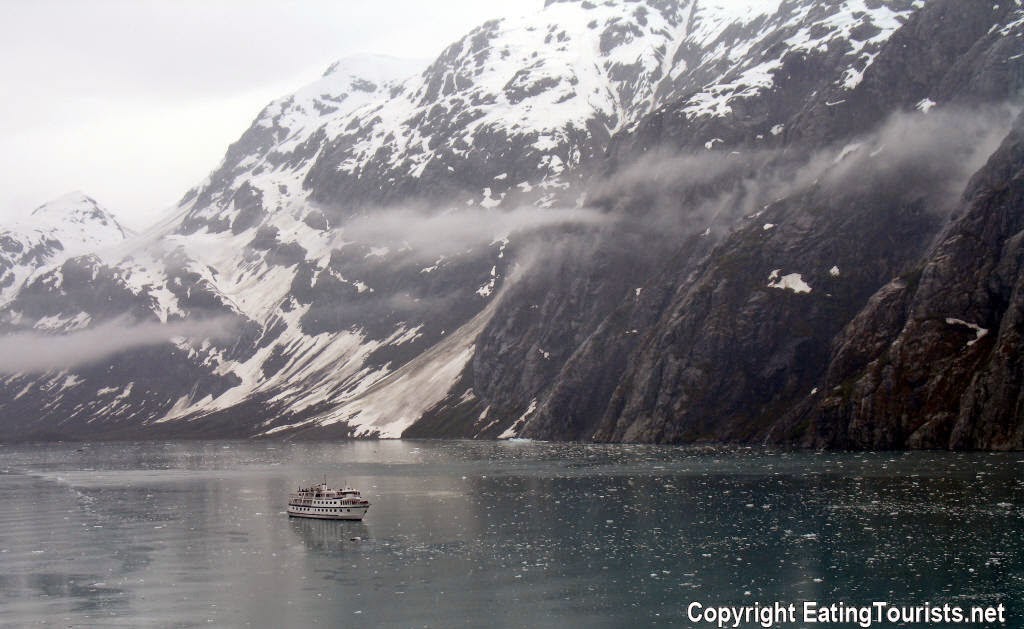
Sightseeing Ship - Glacier Bay, Alaska
So you're probably already using a camera that is more than good enough, and that's easy to carry. A good photographer can make even the most basic point and shoot camera sit up, beg, and roll over, and that's because he or she understands the principles of photography.

Magnificent Marjorie Glacier - Glacier Bay, Alaska
If you want to improve, most people will get ten times the benefit from a $30 book about basic photography than they'll get from $3000 worth of new camera equipment. So in end, the "best camera for travel photography" is almost certainly the one you're already using.

The Awesome Beauty Of The 49th State - Glacier Bay, Alaska
We'll revisit Alaska again in later posts (we've traveled there six times, and it's a favorite subject for Vicky and me) and we'll cover some of the basic principles of good photography then, so you can get the most out of the camera you already have.

Dusk At Midnight - Near Whittier, Alaska
Note that none of these photographs of Alaska were shot with a DSLR camera. All were taken with a point and shoot.

Fox & Vicky